
Tennis Video Editor for Mac
August 12, 2026
If you record your tennis and you work on a Mac, you are in the fortunate position of having real choices. Every general editor worth using runs on macOS, iMovie is already installed, and the tennis-specific apps are here too.
So the question isn’t whether anything exists. It’s which job you’re actually trying to get done — because the tools split cleanly along that line, and picking the wrong side of it is how people end up with a $300 app they use twice.
The short answer
| What you’re trying to do | What to use |
|---|---|
| Trim a clip to send to someone | iMovie — free, already on your Mac |
| Build something polished by hand | Final Cut Pro or DaVinci Resolve |
| Analyse your game — line calls, shot stats, coaching | A tennis analytics app |
| Turn a long session into rally clips without doing it yourself | An app that detects rallies. That’s what this page is mostly about |
The part that’s actually hard
It isn’t the cutting. Any editor cuts.
The problem is that most of a tennis recording isn’t tennis — the ball is in play for well under a quarter of the total time. A two-hour session is maybe twenty-five minutes of play, broken into a hundred-odd rallies of eight to twenty seconds.
Editing a hundred short clips is trivial. Locating a hundred boundaries means watching two hours with your hand on the scrubber. That’s the work, and no general-purpose editor removes it.
What iMovie and Final Cut will do
Both are good, and on a Mac you already have at least one of them.
- iMovie — free, installed, perfectly capable of trimming and joining clips. Fine up to a handful of rallies.
- Final Cut Pro — fast, keyboard-driven, genuinely pleasant for this once you know the shortcuts. If you already own it, marking rallies is about as quick as manual marking gets.
- DaVinci Resolve — free, more powerful than either, and considerably more than this job needs.
For a whole session the arithmetic is the same in all three. A hundred rallies at twenty seconds of marking each is over half an hour of clicking, on top of the two hours of watching. People do it once.
The automatic options
This is where a Mac differs from a PC: the tennis-specific tools are available to you.
SwingVision is the established name, and it’s a serious product — automatic line calling, shot-by-shot statistics, scoring, coaching insight, live feedback while you play, Apple Watch integration. On a Mac it’s the iOS app running on Apple Silicon, part of the same Apple-ecosystem product as the iPhone and iPad versions. If you want a full analytics suite and you’re already in that ecosystem, it’s hard to beat and nothing here is meant to suggest otherwise.
Rallytics is narrower on purpose. It does one thing — find the rallies in a recording and give you clips — and it’s a desktop application, written for a Mac rather than adapted to one.
Which of those you want depends less on features than on what you’re going to do on Sunday evening with two hours of footage.
Where Rallytics is different
It’s built for the clips, not the analytics. There are no line calls, no shot counts, no coaching. You get rallies, a review pass, and an export. If you want the data, this is the wrong tool and the previous section is the right one.
Your original footage never leaves your Mac. To find the rallies, Rallytics makes a small low-resolution copy locally and sends only that away. The original stays put, and the actual cutting happens on your machine against the full-quality file. What leaves is a description of your video, not the video.
It isn’t fussy about how you filmed. No required camera height or angle — it isn’t measuring the court, it’s recognising what’s happening. Side-on, handheld, a phone in the fence, a GoPro on a tripod. 4K works, and isn’t held back for a higher tier.
Your library lives in the Finder. Originals, rallies and exports are ordinary files in ordinary folders. They don’t expire, they don’t depend on a subscription still being paid, and Time Machine backs them up like anything else. Tennis video is big and it accumulates; a phone is not where a season should live.
No subscription. You buy processing time when you need it: $4.99 covers three hours, $11.99 covers eight, and an Annual Pass at $89.99 — one payment, no auto-renewal — releases eight hours a month for a year.
What it looks like
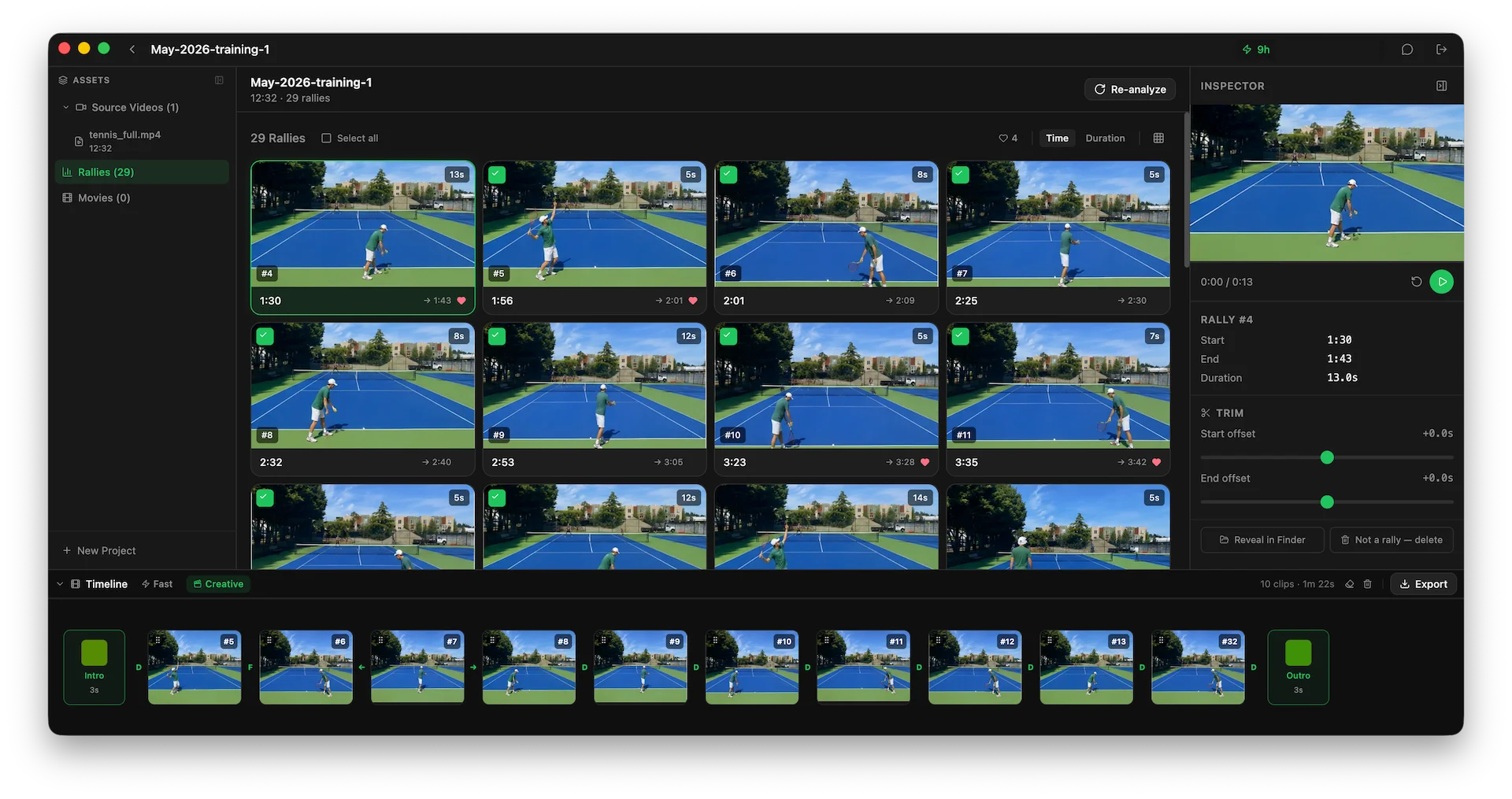
Point it at a file on your disk. It works through the recording and returns the rallies as a grid of thumbnails, each with a start, an end and a duration.
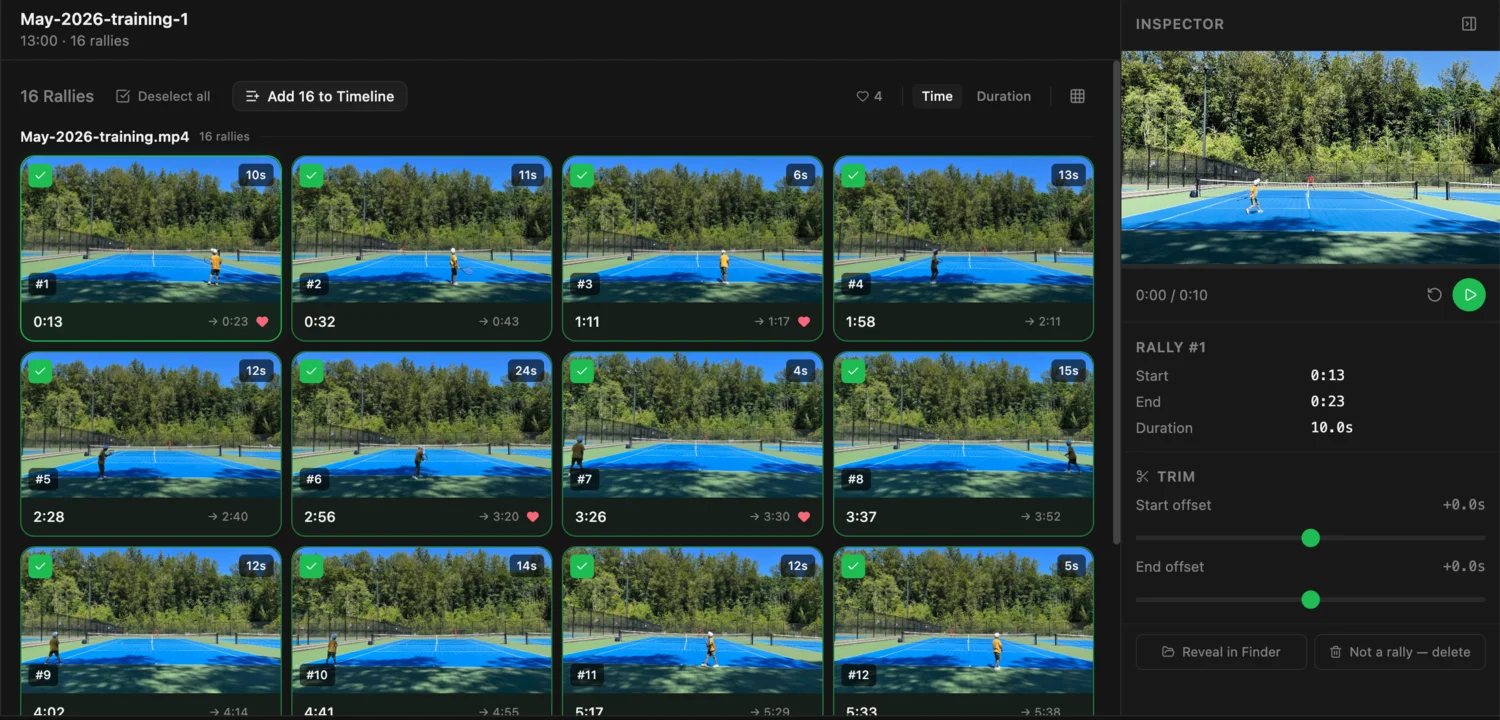
Review them: play one, nudge the in or out point if the cut isn’t right, keep the good ones, delete anything that wasn’t a rally. Detection is good but not infallible, and correcting it is a click.
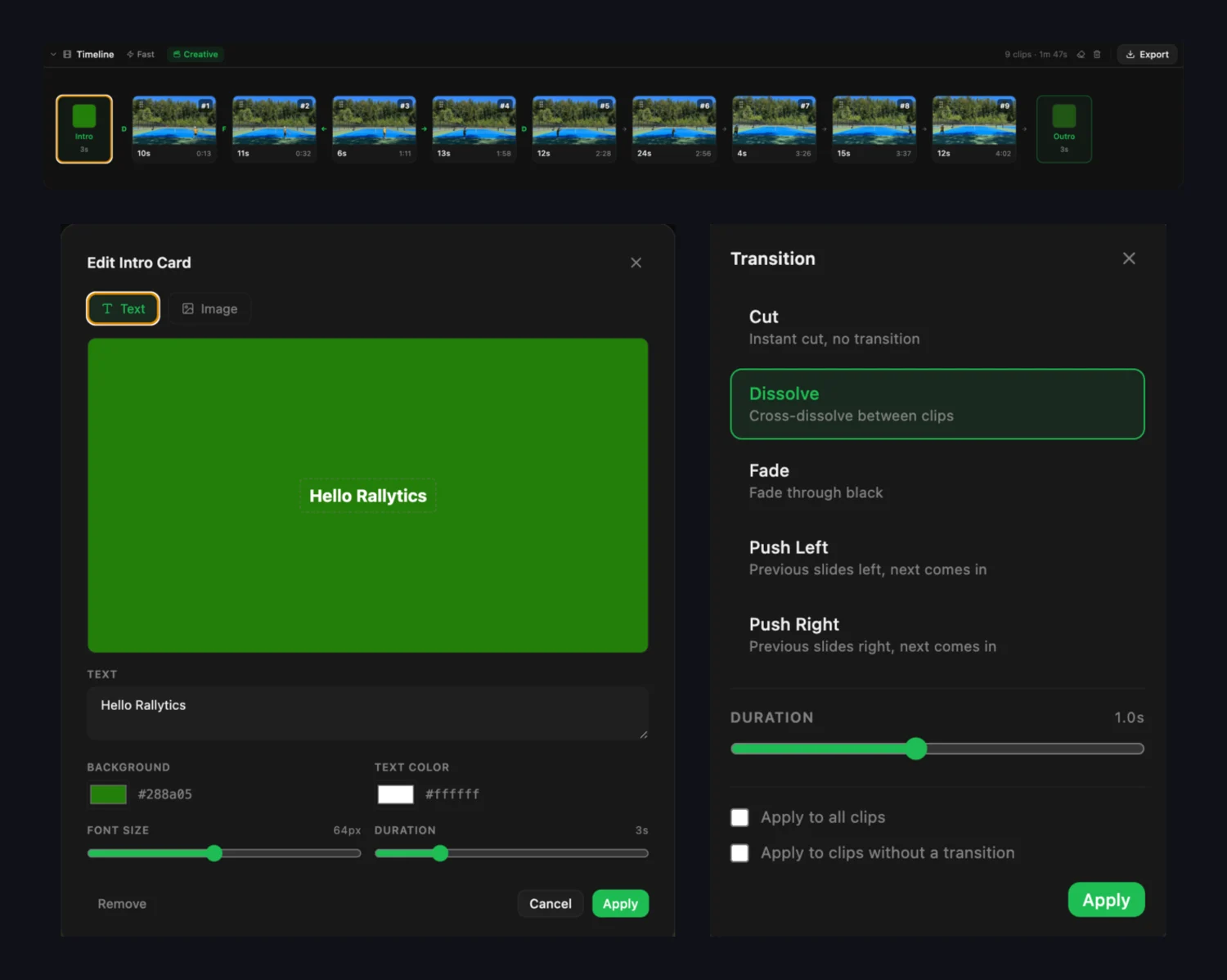
Then drag the keepers into order and export a single MP4, optionally with an intro card, an outro and transitions.
Getting started on a Mac
- Download it from the download page — macOS 12 or later, Apple Silicon. It’s free to install.
- Add a video. You’ll be asked whether to copy it into the app’s folder or reference it where it sits. If your footage is already on an external drive you back up, reference it and save the duplication.
- Analyse. New accounts include two hours, no card required — enough for a full session.
- Review the rallies, trim what needs trimming, drop the false positives.
- Export the keepers as one highlight movie.
When something else is the better call
Plainly:
- You want to know how you played, not just watch it. Line calls, shot statistics, coaching — that’s a different category of product, and you should buy one of those instead.
- You film most weeks. A subscription including tens of hours a month rewards heavy use; a pay-as-you-go tool that pays for AI processing on every analysis can’t match that at volume.
- You have an Intel Mac. Rallytics needs Apple Silicon. There’s a Windows version if you have a PC around; otherwise iMovie is still there.
- You enjoy editing. Some people do, and Final Cut is a nicer place to spend an evening than a rally grid.
Rallytics is for the case in between: hours of footage on the Mac, a wish to see the tennis in it, and no appetite for scrubbing.
Common questions
Does it work on an Intel Mac? No — macOS 12 or later on Apple Silicon. There’s a Windows build for Windows 10 or later.
Do I have to upload my match? Not the match itself. A small low-resolution copy is sent for analysis; the original stays on your Mac and all cutting and exporting is local.
What files does it take? Standard video files — MP4 from phones, action cameras and camcorders. 4K is supported.
Does the camera have to be positioned a particular way? No. If a person watching could tell what was happening, it generally works.
Can I use it alongside another tennis app? Yes. It reads ordinary video files and doesn’t take custody of anything, so there’s nothing stopping you from analysing a match in one app and cutting highlights in this one.
Is there a free version? New accounts get two hours of analysis, no card required. After that you buy processing time in packs — no subscription, nothing auto-renews.
Try it on your own footage
The only test that means anything is your own video. Install it, point it at your longest recording, and see what comes back — the included two hours cover a full session.
On a PC as well? There’s a Windows version of this guide. Coming from another app? See the SwingVision comparison.